MEPCO Tariff 2026: Unit Rates for Homes
Last checked 26 September 2026
These are the rates a MEPCO home is billed at today, taken line by line from NEPRA's published decisions. Pick your category, find your slab, and you know the price of every unit.
Want a total instead of a table? Use the MEPCO bill calculator or the ready-made bill amounts for 100 to 700 units. Shops, industry and tube-wells have their own commercial and industrial tariff.
Which category are you in?
| Category | Who it covers |
|---|---|
| Lifeline | A single-phase connection with sanctioned load up to 1 kW. The highest month in the last twelve, and the current month, must be 100 units or less. |
| Protected | A home on a normal (non-ToU) meter that used 200 units or less in every one of the past 6 months. |
| Un-protected | Every other home on a normal meter. One month above 200 units puts you here for at least 6 months. |
| Time of use (ToU) | Homes with sanctioned load of 5 kW and above. They get a time-of-use meter and pay peak and off-peak rates. |
Definitions: NEPRA determination of MEPCO's supply tariff dated 7 January 2026, Part II, A-1 Residential.
The protected and un-protected consumer guide explains the six-month rule in detail.
Un-protected home rates
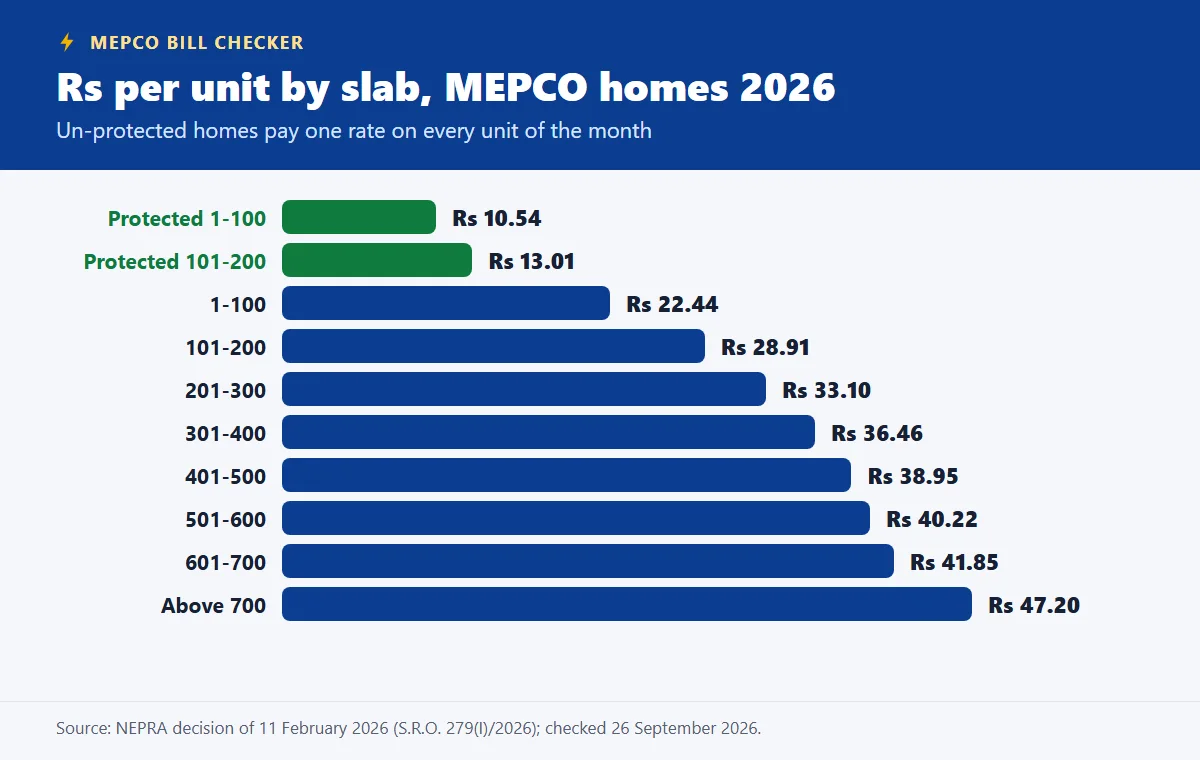
Un-protected homes pay one rate on every unit of the month, set by the slab the total falls in. At 250 units, all 250 units cost Rs 33.10 each.
| Units in the month | Rs per unit | Fixed Rs per kW |
|---|---|---|
| 1-100 units | 22.44 | 275 |
| 101-200 units | 28.91 | 300 |
| 201-300 units | 33.10 | 350 |
| 301-400 units | 36.46 | 400 |
| 401-500 units | 38.95 | 500 |
| 501-600 units | 40.22 | 675 |
| 601-700 units | 41.85 | 675 |
| Above 700 units | 47.20 | 675 |
Protected home rates
Protected homes get the benefit of one previous slab. At 150 units, the first 100 cost Rs 10.54 each and the other 50 cost Rs 13.01 each.
| Units in the month | Rs per unit | Fixed Rs per kW |
|---|---|---|
| 1-100 units | 10.54 | 200 |
| 101-200 units | 13.01 | 300 |
Lifeline rates
Lifeline homes get no slab benefit, so 80 units are all billed at Rs 7.74. There is no fixed charge. Instead, a home that pays no fixed charge pays a minimum of Rs 75 a month on a single-phase connection, or Rs 150 on three-phase, even if no units are used.
| Units in the month | Rs per unit | Fixed charge |
|---|---|---|
| 1-50 units | 3.95 | None |
| 51-100 units | 7.74 | None |
Time-of-use rates
Peak hours change with the season. See MEPCO peak hours.
| ToU meter | Rs per unit | Fixed Rs per kW |
|---|---|---|
| Peak hours | 46.85 | - |
| Off-peak hours | 34.53 | 675 |
Adjustments on current bills
On top of the base rate, NEPRA sets a fuel charges adjustment every month and a quarterly adjustment every quarter. Both appear as separate lines on the bill. These are the ones on bills issued now:
| Adjustment | Rs per unit | On which bills |
|---|---|---|
| Fuel charges adjustment for July 2026 | 2.0581 | Charged in September 2026 bills on the units billed for July 2026 |
| Quarterly adjustment for April to June 2026 | 0.5194 | Billed at a uniform rate from September to November 2026 |
Before this, bills from June to August 2026 carried a quarterly refund of Rs 1.9857 a unit (S.R.O. 953(I)/2026). That refund has ended, which is one reason September bills can look higher. The fuel and quarterly adjustment guide explains how these are set.
Bills also carry the federal government's debt servicing surcharge, charged under section 31(8) of the NEPRA Act to repay power-sector debt: Rs 3.23 a unit, Rs 0.43 for protected homes and nothing for lifeline homes. NEPRA allowed these rates in its decision of 30 March 2023, and all of them have applied since 1 November 2023. The bill calculator on this site includes it.
Taxes
- General sales tax at the standard rate of 18% on the total billed for electricity, including fixed charges, adjustments, the surcharge and the electricity duty. More in taxes on a MEPCO bill.
- Income tax on larger bills of consumers who are not on FBR's active taxpayer list.
- Electricity duty, but no PTV fee. The provincial electricity duty is still printed at 1.5% of the cost of electricity and fixed charges on 2026 MEPCO bills. The PTV fee has shown as zero or blank since July 2025.
What changed in 2026
- January 2026: NEPRA reset the tariffs of all distribution companies for calendar year 2026. The government notified MEPCO's rates in S.R.O. 47(I)/2026 on 13 January 2026.
- February 2026: NEPRA approved the government's rationalization of tariffs on 11 February 2026, notified as S.R.O. 279(I)/2026 the next day. Every home except lifeline now pays a fixed charge of Rs 200 to Rs 675 per kW. For homes above 300 units and ToU meters, the unit rate was cut to offset the higher fixed charge.
- June 2026: NEPRA turned down MEPCO's request for a review of its tariff determination. Consumer rates did not change.
To check for newer changes, see NEPRA's MEPCO tariff page, which lists every decision and notification.
Source: NEPRA decision of 11 February 2026, notified as S.R.O. 279(I)/2026 dated 12 February 2026. Checked 26 September 2026. Debt servicing surcharge: NEPRA decision of 30 March 2023 on the federal government's surcharge motion (rates by category, page 8); NEPRA decision of 7 September 2026 on use of system charges (paragraph 12); NEPRA decision of 9 December 2025 on the incremental consumption package (S.R.O. 2409(I)/2025); Sales Tax Act 1990, section 2(46)(i), FBR text updated to 2025-26.