Protected and Un-protected MEPCO Consumers
Last checked 26 September 2026
A protected consumer is a MEPCO home on a normal (non-ToU) meter that used 200 units or less in each of the past six months. It pays Rs 10.54 a unit on its first 100 units and Rs 13.01 on units 101 to 200, the lowest rates after lifeline. Every other home on a normal meter is un-protected and pays from Rs 22.44 a unit. This guide sets out each category's test, the six-month rule, the slab benefit, lifeline, ToU homes and the 2026 subsidy registration.
The four home categories at a glance
NEPRA's determination of MEPCO's supply tariff, dated 7 January 2026, places every home on the residential tariff A-1 in one of four categories. The table sets each qualifying test beside the way that category's units are billed:
| Category | Who qualifies | How units are billed |
|---|---|---|
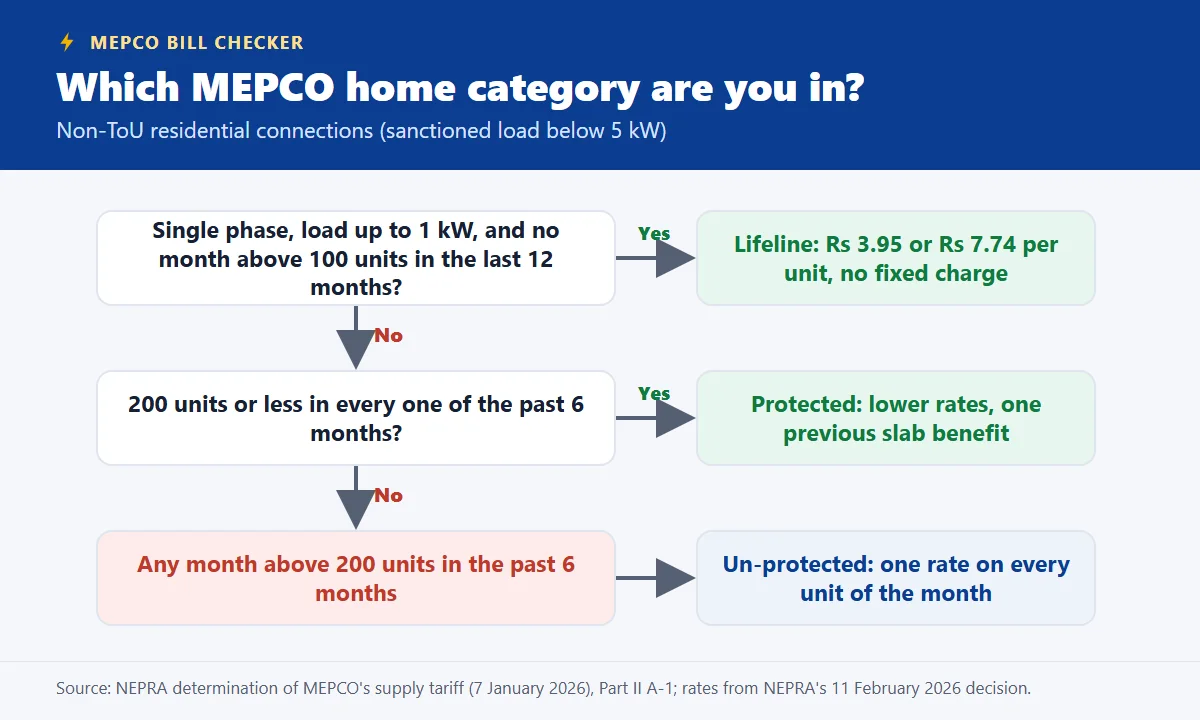
| Lifeline | A single-phase connection with sanctioned load up to 1 kW on a normal meter, whose highest month in the last 12 months and the current month is 100 units or less | Two low rates, no slab benefit, no fixed charge |
| Protected | A home on a normal meter that used 200 units or less in each of the past 6 months | Lower rates on the first 200 units, with the benefit of one previous slab |
| Un-protected | Every other home on a normal meter | One rate on every unit, set by the month's slab |
| Time of use (ToU) | A home with sanctioned load of 5 kW and above | Peak and off-peak rates by time of day |
Lifeline, protected and un-protected homes all have a sanctioned load below 5 kW. NEPRA's rate schedule lists them together under that heading and gives ToU homes a separate line.
How does the 200-unit, six-month rule work?
A home stays protected only while each of its last six monthly readings is 200 units or less. One month above 200 ends protected billing, and the home pays un-protected rates until it has six such months in a row again.
NEPRA defines protected consumers as non-ToU homes using 200 kWh or less "per month consistently for the past 6 months". The month that crosses the line is billed at un-protected rates straight away, because the protected rates stop at 200 units. At 201 units, energy alone costs 201 × Rs 33.10 = Rs 6,653.10, against Rs 2,355 for 200 protected units.
Protected status then takes six months to rebuild. A home that used 230 units in July 2026, for example, needs six months in a row at 200 units or less, such as August 2026 to January 2027, to qualify again.
What if a late reading pushes you over 200?
NEPRA's tariff terms define a billing month as 31 days or less from the last reading. When a reading period runs longer than the calendar month, the units are prorated to that month's days to decide the slab. The NEPRA Consumer Service Manual adds that where readings have piled up over several months, MEPCO prepares a separate bill for each month so the slab benefit is kept. If a late or missed reading has put a month above 200 units, ask for a MEPCO bill correction for a wrong reading.
How can you tell which rates you are paying?
The cost of electricity line on your bill shows it. At 120 units, a protected home is charged Rs 1,314.20 (100 × Rs 10.54 plus 20 × Rs 13.01) and an un-protected home Rs 3,469.20 (120 × Rs 28.91). The history box lists your recent months, so you can count any above 200; the MEPCO bill history guide explains what else to look for.
How do you get protected status back?
Protected status returns only after six months in a row at 200 units or less. These practical steps help keep each month under the line:
- Check each bill with the MEPCO online bill check and compare its present reading with your meter.
- Track your units against 200 in the weeks before the reading date printed on the bill.
- Challenge a wrong reading at once through MEPCO's complaint channels.
- Keep your sanctioned load below 5 kW unless you need more, since 5 kW brings a ToU meter.
What do protected and un-protected homes pay per unit?
Protected homes pay Rs 10.54 and Rs 13.01 a unit; un-protected homes pay Rs 22.44 to Rs 47.20. For the first 100 units, the un-protected rate is more than double the protected one.
Protected rates, with the fixed charge per kW of sanctioned load for each slab:
| Units in the month | Rs per unit | Fixed Rs per kW |
|---|---|---|
| 1-100 units | 10.54 | 200 |
| 101-200 units | 13.01 | 300 |
Un-protected rates, where the rate for the month's slab applies to every unit:
| Units in the month | Rs per unit | Fixed Rs per kW |
|---|---|---|
| 1-100 units | 22.44 | 275 |
| 101-200 units | 28.91 | 300 |
| 201-300 units | 33.10 | 350 |
| 301-400 units | 36.46 | 400 |
| 401-500 units | 38.95 | 500 |
| 501-600 units | 40.22 | 675 |
| 601-700 units | 41.85 | 675 |
| Above 700 units | 47.20 | 675 |
Protected homes also pay a lower federal debt servicing surcharge: Rs 0.43 a unit against Rs 3.23 for un-protected homes, under NEPRA's decision of 30 March 2023. Lifeline homes do not pay it.
For estimated bill totals with adjustments, the surcharge and tax, see the MEPCO bill for 100 to 700 units. The complete MEPCO tariff for 2026 brings every home category's rates together.
Who pays for the lower protected rates?
The gap is covered by subsidy and cross-subsidy. In figures the Ministry of Energy presented at NEPRA's February 2026 hearing, supplying a unit to homes using up to 300 units cost Rs 36.13, while protected homes paid an average of Rs 11.05, a gap of Rs 25.08 a unit. Homes above 300 units and on ToU meters paid an average of Rs 42.25 against a cost of Rs 35.29, or Rs 6.96 a unit above cost.
These figures cover all former WAPDA distribution companies together, not MEPCO alone. The Ministry also counted 20,170,487 protected consumers across those companies in 2026, 59% of their 34,274,946 residential consumers, up from 7,856,737 (28%) in 2022.
What is the one-previous-slab benefit?
The one-previous-slab benefit lets a protected home pay the lower first-slab rate on its first 100 units even when the month goes above 100. NEPRA gives it to protected homes only.
At 150 units, a protected home pays 100 × Rs 10.54 = Rs 1,054 plus 50 × Rs 13.01 = Rs 650.50, or Rs 1,704.50. If all 150 units were billed at the 101-200 rate, the charge would be Rs 1,951.50, so the benefit is worth Rs 247 that month. An un-protected home at 150 units pays Rs 28.91 on every unit: Rs 4,336.50.
Lifeline homes get no slab benefit. At 50 units a lifeline home's energy is 50 × Rs 3.95 = Rs 197.50, but the 51st unit moves the whole month to Rs 7.74: 51 × Rs 7.74 = Rs 394.74.
Who is a lifeline consumer?
A lifeline consumer is a home with a single-phase connection and sanctioned load up to 1 kW, on a normal meter, whose highest month in the last 12 and the current month is 100 units or less.
Lifeline homes pay one of two rates, depending on whether the month is above 50 units:
| Units in the month | Rs per unit | Fixed charge |
|---|---|---|
| 1-50 units | 3.95 | None |
| 51-100 units | 7.74 | None |
Four more rules set a lifeline bill apart:
- no fixed charge, but a minimum charge of Rs 75 a month on a single-phase connection, even if no units are used;
- no slab benefit, as the 51-unit example above shows;
- no fuel charges adjustment for July 2026 and no quarterly adjustment on September to November 2026 bills;
- a 12-month look-back, so one month above 100 units rules out lifeline rates for that month and the 12 that follow.
Why are ToU homes neither protected nor un-protected?
Homes with sanctioned load of 5 kW and above are billed on the time-of-use tariff A-1(b), and NEPRA's protected and un-protected categories cover non-ToU homes only.
A ToU home pays Rs 46.85 a unit in peak hours and Rs 34.53 off-peak, plus Rs 675 per kW on 50% of the sanctioned load or the month's MDI, whichever is higher. Its low-use months earn no protected rate.
The 5 kW line matters before you ask for more load. NEPRA's terms put every home of 5 kW and above on a ToU meter, and the Consumer Service Manual says that when a single-phase meter's load approaches 5 kW, MEPCO issues a notice to extend the load and installs a ToU meter. A low-use home that moves to 5 kW therefore leaves the protected category. Weigh this before a MEPCO load extension.
How is subsidy eligibility checked in 2026?
Subsidy eligibility is checked through PITC's Cross Subsidy Program portal, which matches the bill's reference number with the registered CNIC. The QR code printed on 2026 bills opens the portal's eligibility check at css.pitc.com.pk with the bill's own reference number already filled in.
The portal, css.pitc.com.pk, describes three steps: enter the reference number, let the system verify it against official records, and receive the relief from the next billing cycle if eligible. It asks only for the CNIC number and the reference number, and tells users whose name does not match the bill to visit the nearest electricity office. Its listed conditions include monthly use within the subsidised units limit, a low-income household and a CNIC that matches the consumer record.
The policy direction is on record. NEPRA's January 2026 determination for MEPCO notes that the National Electricity Plan provides for subsidies to protected residential consumers to be disbursed directly. The portal itself does not mention protected consumers or the 200-unit rule; the link comes from government statements reported in the press. Business Recorder reported on 1 June 2026 that Energy Minister Awais Leghari said the government is not withdrawing power subsidies for protected consumers, and that subsidies continue for eligible consumers through the QR code-based verification. The step-by-step process is in MEPCO bill subsidy registration by QR code.
Sources: NEPRA determination of MEPCO's supply tariff, 7 January 2026 (Part I definitions, Part II A-1, paragraph 19.3); NEPRA decision of 11 February 2026 (Annex-A-1 rates and notes, paragraphs 13 and 15), notified as S.R.O. 279(I)/2026; NEPRA decisions of 4 September 2026 on the July 2026 fuel charges adjustment and the April to June 2026 quarterly adjustment; NEPRA Consumer Service Manual as on 26 November 2025 (sections 2.14 and 6.4); PITC Cross Subsidy Program portal; Business Recorder, 1 June 2026. Checked 26 September 2026. Debt servicing surcharge: NEPRA decision of 30 March 2023 on the federal government's surcharge motion (rates by category, page 8); NEPRA decision of 7 September 2026 on use of system charges (paragraph 12); NEPRA decision of 9 December 2025 on the incremental consumption package (S.R.O. 2409(I)/2025); Sales Tax Act 1990, section 2(46)(i), FBR text updated to 2025-26.