MEPCO Net Metering and Net Billing 2026
Last checked 26 September 2026
New MEPCO solar applicants have been on net billing since 9 February 2026: every unit you import is charged at the normal tariff, and every unit you export is bought at the national average energy purchase price (NAEPP) that NEPRA sets. Consumers with an older net-metering agreement keep its terms until it expires, unless they raise the system's output. This guide covers who qualifies, how to apply for a green meter, the time limits and how a solar bill is worked out.
The 2026 prosumer rules at a glance
NEPRA's Prosumer Regulations 2026, notified as S.R.O. 251(I)/2026, apply to every new application to connect solar, wind or biogas generation from 9 February 2026. They have been amended twice: S.R.O. 547(I)/2026 of 2 April 2026 protects existing net-metering agreements, and S.R.O. 709(I)/2026 of 28 April 2026 sets the concurrence fee. PITC's Net Billing Portal summarises the rules that matter most:
- New applications from 9 February 2026 are handled under net billing, not unit-for-unit net metering.
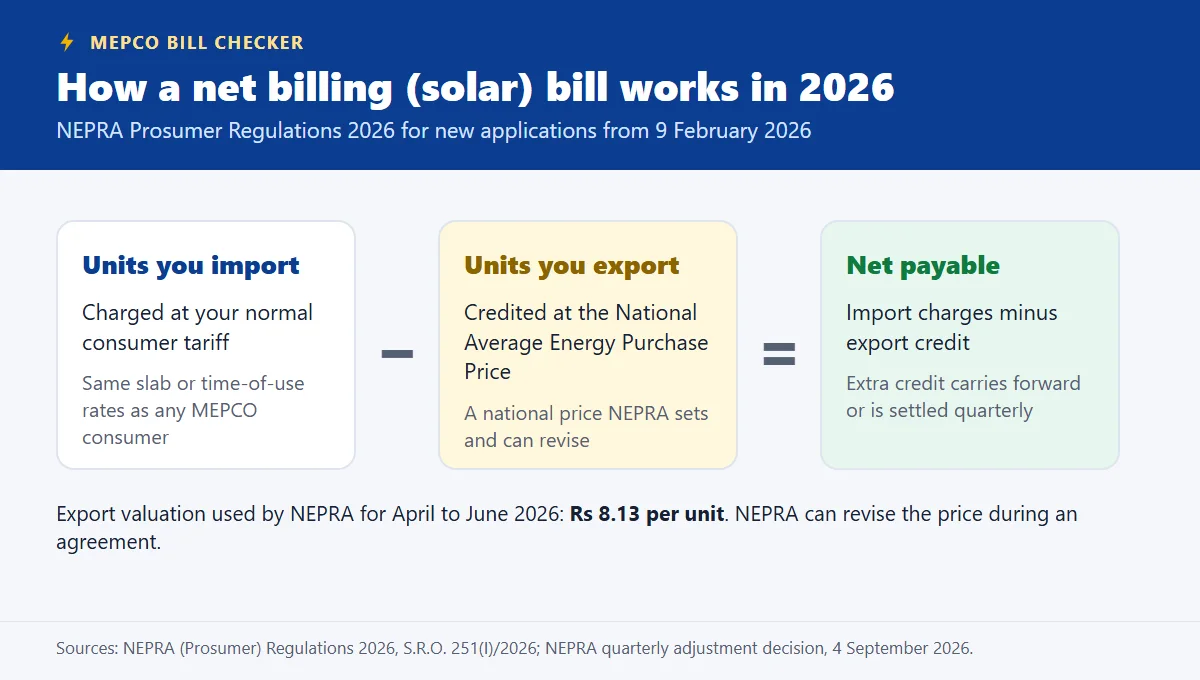
- Imported units are charged at the normal consumer tariff; exported units are bought at the National Average Energy Purchase Price (NAEPP), which NEPRA can revise during the agreement.
- Excess export credit carries forward to the next bill or is settled quarterly by the distribution company.
- The distributed generation capacity cannot exceed the sanctioned load (it was 1.5 times the sanctioned load under the 2015 net metering rules); minimum 1 kW, maximum 1 MW.
- Eligible technologies are solar, wind and biogas; eligible consumers include domestic, commercial, industrial, agricultural, general services and single-point bulk supply connections with a three-phase 400 V or 11 kV connection.
- PITC's summaries of the regulations cap the distributed generation connected to one transformer at 80% of its rating; no new applications are accepted on a transformer at that cap.
- NEPRA concurrence replaced the licence; the concurrence fee is nil up to 25 kW and Rs 1,000 per kW above 25 kW (S.R.O. 709(I)/2026); a concurrence lapses if the system is not commissioned within 6 months.
- The agreement runs 5 years and can be renewed for 5 more years by mutual consent.
- Existing net-metering agreements keep their billing mechanism and export rate until the agreement expires, unless a modification increases the maximum output (S.R.O. 547(I)/2026).
MEPCO's website still hosts its 2015 and 2016 net-metering SOP, application form and agreement, issued under NEPRA's S.R.O. 892(I)/2015. They describe the old regime and do not apply to new applicants.
Who keeps net metering?
Consumers who already had a net-metering agreement keep its billing mechanism, export rate and other benefits until the agreement expires. S.R.O. 547(I)/2026 made this protection explicit and gave it effect from 9 February 2026.
The protection ends early if a material modification changes the system's maximum electrical output. PITC's change matrix gives examples of both outcomes:
- Protection stays when panels or the inverter are replaced with the same output.
- Protection is lost when capacity is increased or extra panels raise the output.
NEPRA's own accounts show the gap in export value. In its quarterly adjustment decision of 4 September 2026, NEPRA accounted for units that consumers of the ex-WAPDA distribution companies, MEPCO among them, exported in April to June 2026 at Rs 25.32 per kWh under net metering and Rs 8.13 per kWh under net billing. These are values in NEPRA's cost accounts, not rates printed on bills.
Who can apply, and how big can the system be?
Domestic, commercial, industrial, agricultural, general services and single-point bulk supply consumers qualify with a three-phase 400 V or 11 kV connection, for a system of 1 kW to 1 MW no larger than the sanctioned load. Solar, wind and biogas qualify; diesel and gas generators do not.
For example, a home with a sanctioned load of 10 kW can connect a system of at most 10 kW. PITC's guidelines for installers add two conditions on the portal itself:
- The sanctioned load cannot be changed on the Net Billing Portal. A MEPCO consumer extends it first through the Power Smart app or the nearest customer facilitation centre; see MEPCO load extension and reduction.
- An application that fails on phase, or on a sanctioned load below 5 kW, needs a change of load first. The portal lets it continue once the load is 5 kW or more, the tariff is one that allows net billing and the demand notice for the load change has been paid.
The 1 kW minimum is the size of the system; on the portal, the connection itself needs a sanctioned load of 5 kW or more.
The local transformer must also have room. PITC's summaries of the regulations cap the generation connected to one transformer at 80% of its rating, which is 80 kVA on a 100 kVA transformer, and no new applications are accepted on a transformer at that cap. Run Check Transformer Overloading on PITC's portal before you commit to a system. Systems of 250 kW or more also need a load flow study by the distribution company or a PEC-registered consultant.
How to apply for a MEPCO green meter
To apply, submit a net-billing application on PITC's Net Billing Portal, yourself or through your installer. The portal forwards it to the MEPCO field office, which handles the rest.
- Check the limits. Confirm the transformer check and your sanctioned load before you apply.
- Agree terms with your installer. Your installer prepares a customer agreement between installer and customer under Schedule 3 of the AEDB (Certification) Regulations, 2021.
- Complete the NEPRA forms. Download the interconnection agreement between the distribution company and the consumer, and NEPRA Schedules II to V, from the portal. Fill them in, sign where required and upload them with the application; PITC warns that incorrect or incomplete documents can lead to rejection.
- Submit the application. Choose Apply for Net Billing (By Consumer), or let your installer use Apply for Net Billing (By Installer). When you apply yourself, your installer validates the application and adds the inverter and PV system details.
- Pay MEPCO's estimate. MEPCO's engineering office verifies the application and issues an estimate and demand notice. After payment, the sub-division issues the material and meter, installs the meter under a meter change order (MCO), and the revenue office updates your billing.
- Track the application. Use Search Application on the portal. Applications made on the earlier Step Robotics system are still processed and tracked there.
Every system also needs a NEPRA concurrence. Up to 25 kW its fee is nil, but the concurrence is still required; above 25 kW the fee of Rs 1,000 per kW means a 50 kW system pays Rs 50,000.
Time limits at each step
The regulations set a time limit for each step, and six of the nine steps fall on the distribution company. The table lists each step, who must act and the time allowed in working days, as summarised on PITC's portal:
| Step | Who acts | Time limit |
|---|---|---|
| Provide forms and documents | Distribution company | 2 working days |
| Acknowledge the application | Distribution company | 5 working days |
| Submit missing documents | Applicant | 3 working days |
| Initial technical review | Distribution company | 15 working days |
| Sign the agreement | Both | 7 working days |
| Send the agreement to NEPRA | Distribution company | 7 working days |
| Issue the connection estimate | Distribution company | 7 working days |
| Pay the estimate | Prosumer | 7 working days |
| Install the interconnection | Distribution company | 15 working days |
Before the system is synchronised with the grid, the prosumer must give the distribution company a testing notice 15 working days in advance. MEPCO then tests the installation and verifies its safety compliance.
What is the green meter?
The green meter is the bidirectional meter that records both the units you import from MEPCO and the units you export to the grid; the regulations also allow two separate meters instead. The sample net meter in MEPCO's reading guide is green and labelled for bi-directional green metering.
PITC's summary of the 2026 regulations lists what the prosumer pays for: the metering, the generation plant, inverters, switchgear and transformers, protection and interconnection equipment, and any distribution upgrades the connection needs. The same summary says that if a meter is not available, the prosumer may buy one, subject to testing by the distribution company. It gives no meter price; what you pay MEPCO is set out in its connection estimate and demand notice.
In a news release of 18 May 2025, MEPCO said it would issue no more no-objection certificates (NOCs) after 16 May 2025 for consumers to buy bidirectional static meters themselves, and that only bidirectional AMI (smart) meters would be installed on new net-metering applications. Under the CSM, as revised on 26 November 2025, distribution companies must offer new three-phase consumers a bidirectional meter at connection, before any generation is installed, when they intend to apply for net metering.
How is a net-billing bill worked out?
A net-billing bill charges every imported unit at your normal tariff and credits every exported unit at the NAEPP; you pay the difference. The example below uses made-up units for a home on a time-of-use meter, the current MEPCO time-of-use rates and the Rs 8.13 per kWh at which NEPRA valued net-billing exports for April to June 2026. That is NEPRA's accounting value for those months, not a rate printed on bills, and the rate applied to your own exports may differ. The example covers the energy lines only.
| Bill line (example) | Units | Rs per unit | Rs |
|---|---|---|---|
| Peak import | 100 | 46.85 | 4,685.00 |
| Off-peak import | 400 | 34.53 | 13,812.00 |
| Import charges | 500 | - | 18,497.00 |
| Export credit | 350 | 8.13 | -2,845.50 |
| Net energy charge | - | - | 15,651.50 |
Rates: NEPRA decision of 11 February 2026, Annex-A-1 (residential time of use); export value: NEPRA quarterly adjustment decision of 4 September 2026, paragraph 23. The units are illustrative.
A real bill also carries fixed charges, the fuel and quarterly adjustments and taxes, which the example leaves out. On a ToU meter the fixed charge is Rs 675 per kW on 50% of the sanctioned load or the MDI, whichever is higher, so a 10 kW sanctioned load carries at least Rs 3,375 a month; the MEPCO fixed charges guide explains the basis. NEPRA's January 2026 determination mentions an older 25% basis for net-metering consumers, but 2026 MEPCO bills of net-metered homes charge Rs 675 on 50% of the sanctioned load or the MDI, whichever is higher, the same as other ToU homes.
If the export credit is larger than the import charges, the excess carries forward to the next bill or is settled quarterly by MEPCO. NEPRA can revise the NAEPP during your agreement, and the revised price then applies automatically. Peak imports cost the most, and MEPCO peak hours fall in the evening in every season, from 5 to 9 PM in December to February and 7 to 11 PM in June to August.
Reading your solar meter
A green meter shows four readings that matter for the bill: peak and off-peak import, and peak and off-peak export. The labelled sample photos in MEPCO's net-meter reading guide show them on display sequences 6 (peak export), 7 (peak import), 8 (off-peak export) and 9 (off-peak import); follow your own meter's display label if it differs. The bill prints the import and export photos and lists imported and exported units separately; open it with the MEPCO bill checker using your 14-digit reference number. To photograph these screens for Apna Meter Apni Reading, follow how to read your MEPCO meter.
If the net meter fails, the CSM credits exported units on an average basis for up to two months, using the higher of the units exported in the same month last year or the last eleven months' average. The meter must be replaced within two billing cycles, and the account is then corrected from data downloaded from the meter.
After you are connected
Changes to a solar connection follow MEPCO's normal procedures, plus the prosumer rules on modifications. Four sets of rules apply once the green meter is in:
- Name change, shifting and load changes follow the same procedure as any other connection under the CSM. For a name change, the CSM, revised in November 2025, also asks for a change of name on the distributed generation licence; the 2026 rules replaced that licence with a NEPRA concurrence, so ask MEPCO which record needs the new name.
- Material modifications, such as more capacity, an inverter replacement that affects output or a change to the interconnection, need 40 working days' notice, a revised application, MEPCO's approval and a fresh NEPRA concurrence.
- Ending the agreement takes 30 days' written notice from you; MEPCO needs 30 days' notice and NEPRA's approval.
- Disputes over billing, technical matters, the agreement or the interconnection go to NEPRA, whose decision is binding.
Other requests on an existing connection are collected under MEPCO consumer services.
Sources: NEPRA (Prosumer) Regulations 2026, S.R.O. 251(I)/2026, with S.R.O. 547(I)/2026 and S.R.O. 709(I)/2026, as summarised on PITC's Net Billing Portal; PITC installer guidelines and net billing flow; NEPRA quarterly adjustment decision of 4 September 2026; NEPRA tariff decision of 11 February 2026; NEPRA Consumer Service Manual as on 26 November 2025; MEPCO news release 135/2025 of 18 May 2025 and Apna Meter Apni Reading net-meter guide (mepco.com.pk). Checked 26 September 2026.